Initial Research
This week I developed the idea of my project for this term. Starting next week, I plan to decide on the design and approximate layout. The design of the pavilions has an impact on human feelings and perception due the light, texture of materials, shape of building and the interaction with environment. Therefore, this experience will be useful for my project and in this research I will analyse the design of different pavilions from the annual Serpentine pavilion installation and their conception as examples for inspiration.
1.


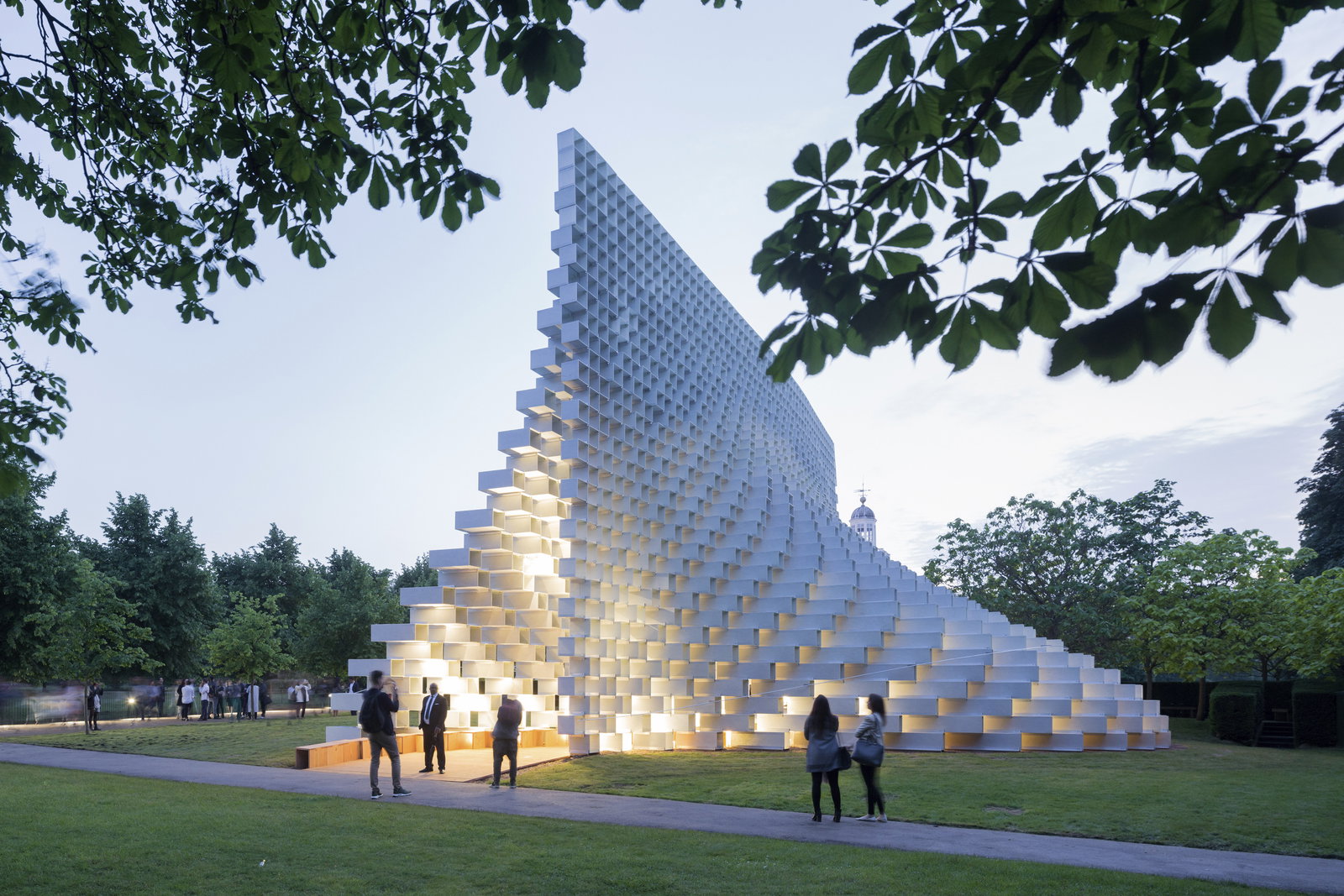
The 2016 Serpantine Pavilion, designed by the BIG bureau, shows how one basic architectural element created from simple modular elements can be transformed into an expressive architectural form. In this pavilion, a brick wall was used as the main element. Each brick was made of translucent material but was opened from both sides. The brick wall was extruded into a cave-like space. The closer to the floor, the stronger the bricks were extruded. The authors of the project called this process "unzipping of the wall". As a result of the shape, translucent material and open brick planes, a game of light and shadow was created inside the pavilion. This pavilion has no doors and a clear entrance-exit. This is an open space that creates a feeling of comfort and shelter while having free access to the environment. This pavilion looks like an integration of nature and architecture. I chose this it as an example because I would like to use simple architectural elements in my project, transforming them into a space integrated with nature and using daylight as a sensory element.
2.

The Serpentine 2009 pavilion is designed by the SANAA bureau. I chose it as an example of how sensory experience is formed with light and reflection. In this project, the roof is made of aluminum and it reflects nature, people and the environment. Using of this material creates the feeling that the line between nature and architecture is blurred. Also, aluminum can be perceived differently depending on the weather or even reflect it. For example, the more sunny the day is, the brighter light is reflected from the roof. Since the material is lightweight, in this project are used very thin columns. The image of this pavilion reminds me of a foggy forest and thin trees in the water. In my project, I would also like to use a similar material on the outside and maybe somewhere else inside.
3.


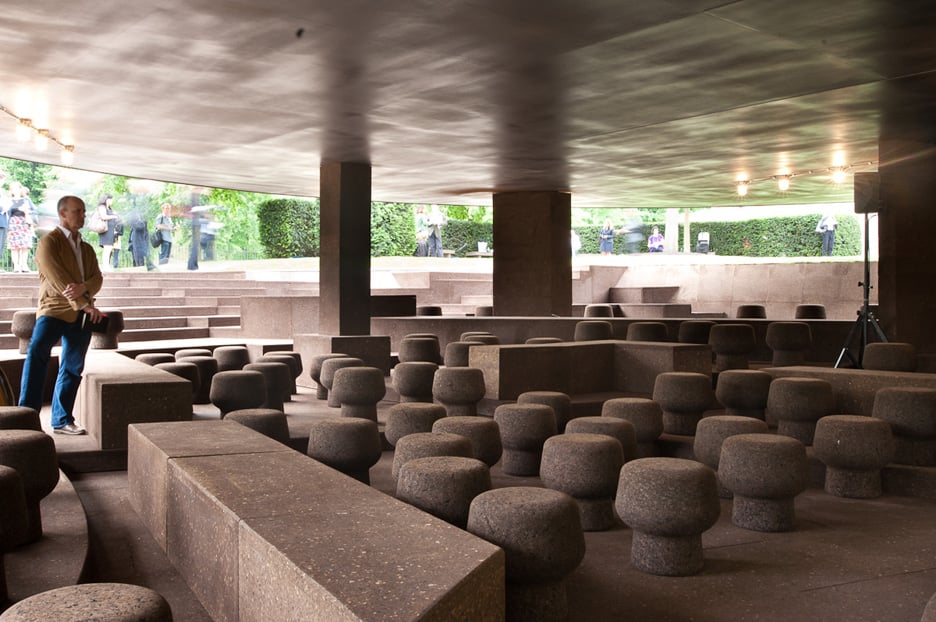
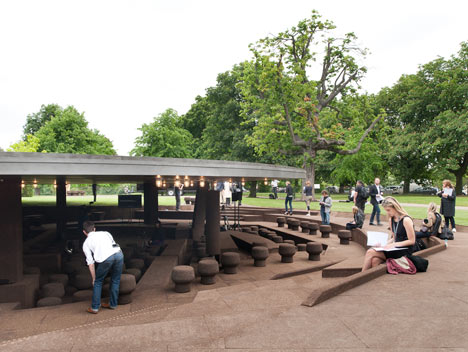
The next example I looked at was the 2012 pavilion designed by Herzog & de Meuron and Ai Weiwei. Unlike the two previous examples, in Pavilion 2012 the sensory element is a physical sensation, not visual expressiveness. In this project authors used cork as a material from which the seats and floor are made. Cork is a material that is perceived as warm compared with stone or metal. Also, the cork is softer if to touch to it, does not reflect light and absorbs sound. As a result, the space looks cosy, calm, with soft light and texture. In this project, the pavilion is partially located in the ground and covered with a roof, creating a feeling of comfort and protection. Therefore, I would like to use a cork-like material in my project.
4.


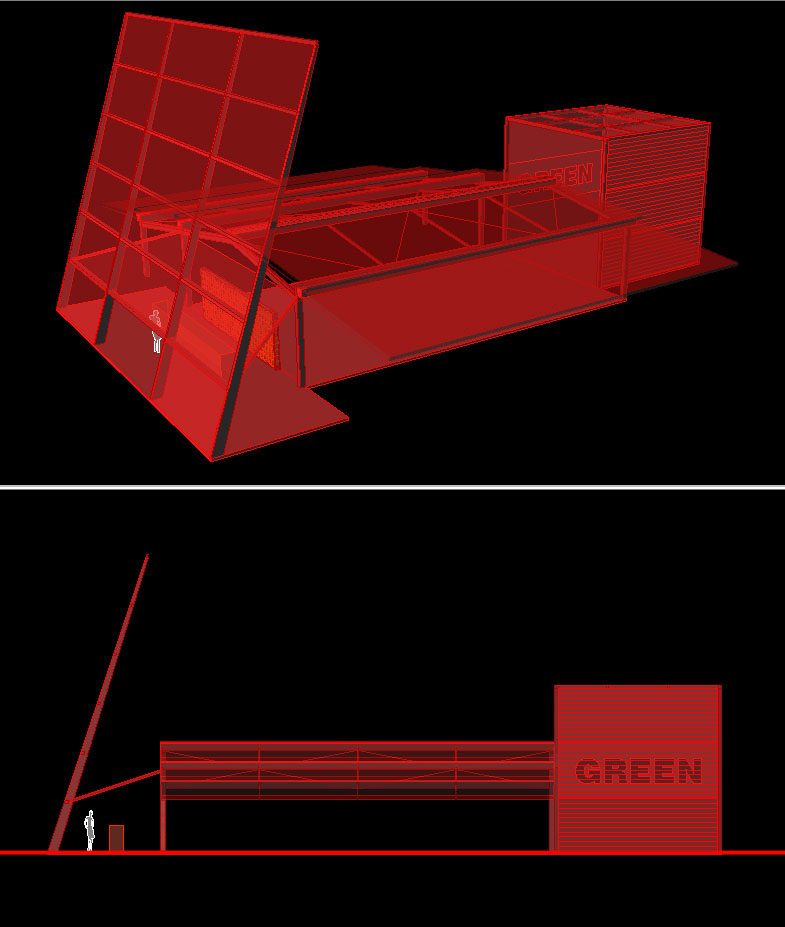
Another example that I looked at is the Serpentine pavilion 2010, designed by architect Jean Nouvel. It has a simple geometry, in comparison with other pavilions, and the accent here is on colour and lighting. Only the side walls are open here and this is an example of how architecture with closed walls can interact with nature if these walls are made translucent. Then, being in the pavilion, a person feels that he is in a shelter, but at the same time he can observe nature. Although nature interacted with architecture, this pavilion does not integrate with nature as it has a red colour that strongly contrasts with the green park. Metal is used here as the frame of the pavilion, textiles and glass, as translucent panels. Since the panels let the light through and because of the geometry of the building, the light and shadows changed from the weather and time and created red reflections and the shadows are layered on each other. It could influenced a person's emotional perception. Since everything has bright red colour, I think this pavilion was perceived as a place of active recreation, communication or concerts. And in my project, I want to use some areas with transparent or translucent closed panels so that a person can be in a comfortable environment and at the same time feel connected to the environment.
Image References:
1. Bjarke Ingels Group (2016) ‘Serpentine Pavilion 2016’, BIG. Available at: https://media.big.dk/2022/07/19_SERP_N953_webproject.jpg?width=1600 (Accessed: 15 February 2026).
2. Bjarke Ingels Group (2016) ‘Serpentine Pavilion 2016’, Metalocus. Available at: https://www.metalocus.es/sites/default/files/metalocus_serpentine_big_10.png (Accessed: 15 February 2026).
3. Baan, I. (2009) ‘Serpentine Pavilion 2009, SANAA’, Metalocus. Available at: https://www.metalocus.es/sites/default/files/metalocus_sanaa_serpentine-gallery_01.jpg (Accessed: 15 February 2026).
4. Stephenson, J. (2016) ‘Herzod & de Meuron and Ai Weiwei’s Serpentine Gallery Pavilion paid homage to its predecessors’, Dezeen. Available at: https://static.dezeen.com/uploads/2016/02/Serpentine-Gallery-Pavilion-2012-by-Herzog-and-de-Meuron-and-Ai-Weiwei_dezeen_08.jpg (Accessed: 15 February 2026).
5. Stephenson, J. (2016) ‘Herzod & de Meuron and Ai Weiwei’s Serpentine Gallery Pavilion paid homage to its predecessors’, Dezeen. Available at: https://static.dezeen.com/uploads/2012/05/dezeen_Serpentine-Gallery-Pavilion-2012-by-Herzog-de-Meuron-and-Ai-Weiwei_2.jpg (Accessed: 15 February 2026).
6. Offenbach, J. (2010) ‘Serpentine Gallery Pavilion 2010 Designed by Jean Nouvel’, Serpentinegalleries. Available at: https://d37zoqglehb9o7.cloudfront.net/uploads/2020/03/15.XI_.M.JO_-1502x1001.jpg (Accessed: 15 February 2026).
7. Nouvel, J. (2010) ‘Serpentine Gallery Pavilion 2010 Designed by Jean Nouvel’, Serpentinegalleries. Available at: https://d37zoqglehb9o7.cloudfront.net/uploads/2020/03/100310-sketch.jpg (Accessed: 15 February 2026)
Text References:
1. Serpentine Galleries (2016) Serpentine Pavilion 2016 and Summer Houses. London: Serpentine Galleries.
2. Alvarez, M. (2021) ‘Evanescence architecture. Serpentine Gallery Pavilion 2009 by SANAA’, Metalocus. Available at: https://www.metalocus.es/en/news/evanescence-architecture-serpentine-gallery-pavilion-2009-sanaa (Accessed: 15 February 2026).
3. Hopkinson, J. (2016) ‘Herzod & de Meuron and Ai Weiwei’s Serpentine Gallery Pavilion paid homage to its predecessors’, Dezeen. Available at: https://www.dezeen.com/2016/02/14/video-interview-serpentine-gallery-pavilion-2012-herzog-de-meuron-ai-weiwei-excavation-movie/ (Accessed: 15 February 2026).
4. Serpentine Galleries (n. d.) ‘Serpentine Gallery Pavilion 2010 Designed by Jean Nouvel’, Serpentinegalleries. Available at: https://www.serpentinegalleries.org/whats-on/serpentine-gallery-pavilion-2010-jean-nouvel/ (Accessed: 15 February 2026).





Add text on how these examples link to what you are doing in more detail. There is little evidence of research here.
ReplyDelete